What Education Is Required for Animation? Tips from the Pros
What education is required for animation? No degree needed. Learn the skills, software, and reel-building paths that actually get animators hired.
Article by Richard Arroyo & iAnimate Team
TLDR: What Education Is Required for Animation?
No degree is required to become an animator — studios hire based on your demo reel, not your diploma. The most direct path is learning the 12 Principles of Animation, mastering industry-standard software like Maya or Toon Boom Harmony, and building a portfolio of strong, polished shots through structured training. Whether you choose a 4-year university, specialized online animation training, or a hybrid approach, every decision should point toward one goal: a reel that proves you can animate.
Key Takeaways
- A degree is not required — the animation industry is portfolio-first; your demo reel is your most important credential
- Three main education paths exist — traditional university (BFA), specialized online animation schools, and self-taught; each has real trade-offs
- The 12 Principles of Animation are non-negotiable — every working animator speaks this language regardless of the path they took
- Industry-standard software matters — Maya for 3D, Toon Boom Harmony for 2D, Blender as a legitimate free alternative
- Quality over quantity on your reel — 30 to 60 seconds of great shots outperforms a long reel of average work every time
- Online animation training is now a legitimate fast track — schools like iAnimate.net offer working-professional instruction without the cost or time of a four-year degree
- A degree has specific value — structure, networking, and visa/HR requirements are real reasons to consider formal education
- Your reel is ready when studios say it is — not when a calendar or a diploma says so
If you're asking what education is required for animation, the honest answer is: it depends far less on a diploma than most people think. What studios are actually hiring for is proof you can animate — clean mechanics, strong weight, a reel that makes them stop scrolling. The path you take to get there, whether that's a four-year BFA, an online workshop, or grinding through shot work on your own, matters a lot less than what you can show at the end of it.
Do You Need a Degree to Become an Animator?
You've probably asked yourself this more than once.
"Will studios even look at me without a degree?"
"Am I wasting time if I skip college?"
"Is a $100k BFA actually worth it?"
Here's the truth: the animation industry is portfolio-first, always.
No recruiter at Pixar, DreamWorks, or Blizzard is opening your application and checking for a diploma first.
They're hitting play on your reel.
That's it.
The Portfolio vs. Degree Debate
Your demo reel is your real degree in this industry.
A 30-second reel with clean body mechanics and strong weight will get you further than a four-year BFA with weak shots.
That said, a degree isn't worthless. It just isn't the point.
What a degree actually gives you:
- Structure — A curriculum that forces you to show up and finish work, which many self-taught animators struggle with
- Networking — Classmates who become industry contacts, professors with studio connections
- Time — Four years of dedicated, focused practice in one place
- Credibility — Some international studios and visa sponsorships require a formal degree on paper
What a degree doesn't give you:
- A guaranteed job
- Current industry workflows
- The specific shot work studios are actually looking for
When a Degree in Animation Is Worth It
If you want structure and you know you won't stay disciplined on your own, a formal program can be the right call.
If you're planning to work internationally and need a work visa, some countries require proof of a formal qualification. That's one real, practical reason a degree matters outside of the craft itself.
But if your goal is to get hired and animate, what education is required for animation really comes down to one thing: can you animate well?
The Smarter Path Most Working Animators Take
Many working animators skip the four-year route entirely or combine a brief formal foundation with focused online animation training that teaches current studio workflows.
Schools like iAnimate.net are built specifically for this.
The workshops are taught by working professionals from top studios, people who know exactly what a recruiter wants to see on a reel right now, not five years ago.
You're not paying for a diploma.
You're paying for the specific skills and shot quality that actually get you hired.
That's the difference.
Comparing Animation Education Paths
So you've decided you want to animate.
Now comes the question everyone gets stuck on:
"Which path do I actually take?"
"Am I going to waste years and money going the wrong direction?"
There's no one-size-fits-all answer here.
But there is a smarter way to think about it.
Let's break down all three paths, honestly.
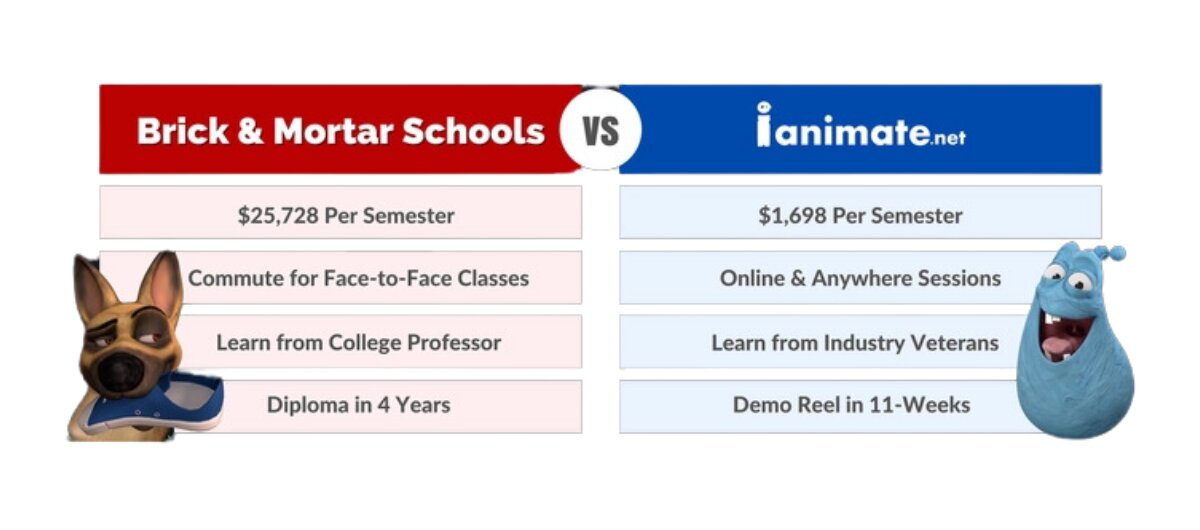
Traditional 4-Year University (BFA/BS/BA in Animation)
This is the path most people's parents know about.
Four years. A campus. A degree at the end.
Schools like CalArts, Ringling, and SCAD have strong reputations — and for good reason.
What you get:
- A structured curriculum from day one
- Access to facilities, equipment, and professors with industry ties
- Classmates who become your future network
- A formal qualification for visa and HR requirements
What you need to watch out for:
- Cost — Four-year programs can run $100k+ in tuition alone
- Outdated curriculum — Some programs still teach workflows that studios abandoned years ago
- Time — Four years is a long runway before you're job-ready
- Reel quality still matters most — A degree from a top school with a weak reel still won't get you hired
Bottom line: If you have the resources and want the full college experience, it can work.
But a BFA alone won't hand you a career.
Your reel will.
Specialized Online Animation Schools & Workshops
This is where the industry has quietly shifted.
A lot of working animators, including people at major studios, built their careers through focused online animation training, not four-year degrees.
What you get:
- Training from working professionals at real studios, not just academics
- Curriculum built around current industry workflows and what recruiters actually want
- Flexibility to learn at your own pace without relocating
- A faster, more direct path to a job-ready demo reel
- Significantly lower cost compared to a traditional university
What to look for in an online animation school:
- Instructors who are actively working in the industry
- Workshop structures focused on shot work: the actual assignments studios want to see
- A community of peers who push your work forward
- Clear focus on the 12 Principles of Animation applied to real-world shot production
iAnimate.net was built exactly around this idea.
Every workshop is taught by animators from top studios who know what a recruiter needs to see, right now, not years ago.
If figuring out what education is required for animation is what brought you here, this path is worth a serious look.
The Self-Taught Route: Is It Feasible?
Short answer, yes.
Longer answer, it's hard, and most people don't finish.
What works about going self-taught:
- Free and low-cost resources are genuinely good now: Blender, YouTube, online forums
- You move at your own speed
- No tuition debt
What makes it brutal:
- No structure — Most self-taught animators stall because there's no one pushing them forward
- No feedback — Animating in a vacuum means bad habits go uncorrected for months or years
- No community — Isolation kills motivation faster than anything
- The reel suffers — Without guidance, it's hard to know what shot work actually gets you hired
Self-study works best as a supplement, not a standalone plan.
Use free tools to explore.
Use platforms like iAnimate.net to get the structured, professional feedback that actually sharpens your work.
So Which Path Is Right for You?
Here's a simple way to think about it:
| Path | Best For | Watch Out For |
| 4-Year University | Structure seekers, visa needs | Cost, potentially outdated curriculum |
| Online Schools & Workshops | Fast, focused, career-driven learners | Picking the wrong school with weak instructors |
| Self-Taught | Explorers and supplements | Lack of structure, no feedback loop |
No matter which path you choose, what education is required for animation always circles back to the same thing.
Can you animate?
Does your reel prove it?
That's the only question that matters when you're sitting across from a recruiter.
Essential Skills: What You Actually Need to Learn as an Animator
Here's where a lot of aspiring animators get lost.
"There's so much to learn — where do I even start?"
"Do I need to know how to draw really well first?"
"What do studios actually expect me to know?"
Good news, it's not as overwhelming as it looks.
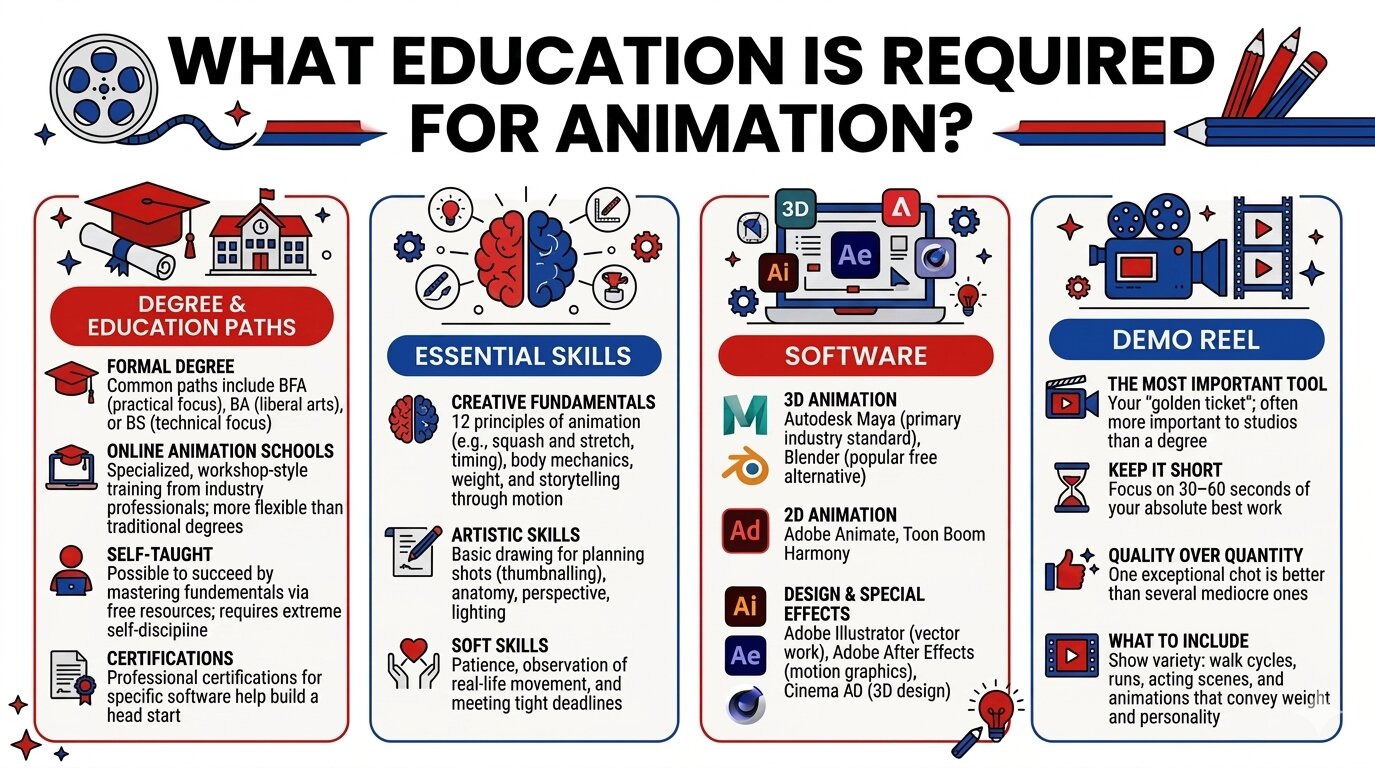
When you break down what education is required for animation, it really comes down to three core areas.
Master these, and you're building on the right foundation.
The 12 Principles of Animation
These are the rules the entire industry runs on.
Disney animators Frank Thomas and Ollie Johnston laid them out decades ago — and they still apply whether you're working in 2D animation, 3D character animation, or even game cinematics.
The 12 Principles every animator needs to know:
- Squash and Stretch — Gives weight and flexibility to movement
- Anticipation — Prepares the audience for what's coming next
- Staging — Presenting an idea so it reads clearly
- Straight Ahead & Pose to Pose — Two core approaches to animating a shot
- Follow Through & Overlapping Action — Makes movement feel natural, not robotic
- Slow In & Slow Out — Controls the feel of acceleration and deceleration
- Arcs — Most natural movement follows a curved path
- Secondary Action — Adds life and depth to a primary movement
- Timing — Controls the mood, weight, and personality of a shot
- Exaggeration — Pushes action beyond reality to sell the performance
- Solid Drawing — Understanding form, weight, and balance
- Appeal — Making characters and motion compelling to watch
These aren't just theories.
Every shot you animate, every walk cycle, every performance piece, every action sequence — lives or dies based on how well you apply these.
This is the language of animation.
Learn it first.
Artistic Fundamentals: Anatomy, Weight, and Storytelling
A lot of people skip this part and wonder why their animation looks off.
Here's the thing, you can't fake good fundamentals.
Studios can tell immediately when an animator doesn't understand how a body actually moves.
What artistic fundamentals really mean:
- Anatomy — Understanding how joints, muscles, and the spine work together in motion
- Weight — Making a character feel heavy or light based on timing and spacing alone
- Body mechanics — How a character physically interacts with their environment
- Storytelling — Every shot needs to communicate something; movement is your tool
- Gesture and silhouette — A strong pose should read clearly even as a shadow
You don't need to be a fine artist.
But you do need to understand how the body moves and why.
That understanding is what separates animators who get hired from those who keep wondering what's wrong with their reel.
The Animator's Survival Kit by Richard Williams is one of the best resources to build this foundation. Read it, study it, and keep it on your desk.
Technical Proficiency: Understanding Pipelines and Rigging
This is the part nobody talks about enough when discussing what education is required for animation.
Knowing how to animate isn't enough.
You need to understand the world your animation lives inside.
What technical proficiency looks like in practice:
- Understanding the production pipeline — How a shot moves from layout to animation to lighting and render
- Working with rigs — You won't build them, but you need to know how to push a rig without breaking it
- Software fluency — Being comfortable in Autodesk Maya, Blender, or whatever tool your target studio uses
- File management and naming conventions — Studios run on organized pipelines; sloppy files slow everyone down
- Basic rendering knowledge — Understanding what happens after you hand off your scene
You don't need to be a character rigger or a VFX artist.
But walking into a studio without understanding the pipeline is like showing up to a construction site not knowing what the other trades do.
It slows you down, and studios notice.
The Bottom Line on Skills
Here's how to think about it:
| Skill Area | Why It Matters |
| 12 Principles | The language every animator speaks |
| Artistic Fundamentals | What moves feel real and compelling |
| Technical Proficiency | How you function inside a real production environment |
All three work together.
You can't skip one and expect the other two to carry you.
The good news, iAnimate.net workshops are designed to develop all three and are taught by animators who use these skills in production every single day.
That's exactly the kind of training that answers the real question behind what education is required for animation.
Not a diploma.
Practical, applicable skills, proven on your reel.
Building a Professional Animation Demo Reel
This is the section that actually changes careers.
"How long should my reel be?"
"Do I need 10 shots to get noticed?"
"Will a weak reel hurt me even if I have a degree?"
Yes, it will.
And a strong reel with no degree will still get you in the door.
That's the reality of this industry.
Why Your Demo Reel Matters More Than Your Diploma
When a recruiter at a major studio opens your application, they're not reading your resume first.
They're hitting play.
You have about 10 seconds to make them keep watching.
That's it.
No diploma changes that.
No list of courses changes that.
Your demo reel is the single most important thing you will ever build as an animator.
It's your handshake, your interview, and your proof of skill — all in one file.
Every decision you make about what education is required for animation should point toward one goal:
"Is this making my reel better?"
If the answer is no, rethink it.
What Recruiters Actually Look For
Here's what nobody tells you clearly enough.
Recruiters aren't looking for quantity.
They're looking for quality, and they can spot the difference in seconds.
What makes a recruiter stop and pay attention:
- Strong body mechanics — Does the character feel like it has real weight?
- Clean spacing and timing — Is the motion controlled and intentional?
- Clear storytelling — Does the shot communicate something without confusion?
- Appeal — Is it compelling to watch?
- Polished shots — A few great shots beat a reel full of average ones every time
What makes a recruiter move on:
- Too many weak shots padding the reel out
- Poor walk cycles presented as showcase work
- Inconsistent quality across shots
- Shots that show technical skill but no personality or performance
- A reel longer than 60 seconds with nothing memorable in it
The Golden Rule: Quality Over Quantity
This is worth repeating because so many animators get it wrong.
A 30 to 60-second reel of truly great shots is more powerful than a 3-minute reel of average work.
Always.
Here's a simple framework for building your reel:
| What to Include | What to Leave Out |
| Your 2 or 3 absolute best shots front and center | Anything you're not proud of |
| Clear character animation with weight and purpose | Filler shots that pad the runtime |
| A mix that shows range — mechanics + performance | Unpolished or unfinished work |
| Shots that reflect current industry standards | Outdated or overly simple exercises |
Lead with your best shot.
End with your second best.
Everything in between should earn its place.
How to Actually Build a Reel Worth Watching
This is where focused online animation training makes a real difference.
Building strong shots doesn't happen by accident.
It happens through guided practice, honest feedback, and instructors who know exactly what studios want to see right now.
A few non-negotiable steps:
- Study reels from working animators — Know what the bar looks like before you try to clear it
- Get feedback constantly — Don't animate in isolation; bad habits compound fast
- Prioritize shot quality over speed — One great shot is worth more than five rushed ones
- Update your reel regularly — Your oldest work should keep getting replaced by better work
- Keep it focused — Pick your specialization and let your reel reflect it clearly
At iAnimate.net, every workshop is built around producing real, portfolio-ready shot work.
Not just exercises.
Not just theory.
Actual shots, critiqued by working professionals who've sat in the same rooms as the recruiters you're trying to impress.
The Real Answer to What Education Is Required for Animation
If there's one thing this entire article points to, it's this.
The education that matters most is the education that builds your reel.
A degree that doesn't improve your shot quality isn't worth the debt.
A workshop that sharpens your body mechanics, strengthens your timing, and pushes your character animation forward?
That's the education worth investing in.
Your reel is the proof.
Everything else is just the path you took to build it.
Industry-Standard Animation Software to Master
This one comes up constantly.
"Do I need to learn Maya, or is Blender fine?"
"What software do actual studios use?"
"Am I wasting time learning the wrong tool?"
These are fair questions, and the answer matters.
Because when you're thinking about what education is required for animation, software fluency is part of the package.
You don't need to master everything at once.
But you do need to know what the industry runs on, and start there.
Autodesk Maya: The Industry Standard for 3D Animation
If you want to work in 3D character animation at a major studio, Maya is the tool.
Full stop.
Pixar, DreamWorks, ILM, Blizzard, the big names run their animation pipelines on Maya.
It's not the easiest software to learn.
But fluency in Maya signals to a recruiter that you're serious and job-ready.
What Maya is used for:
- Character animation and performance
- Body mechanics and walk cycles
- Rigging and skinning (though animators focus more on using rigs than building them)
- Rendering pipelines at major studios
What to know going in:
- The learning curve is real, give it time
- Focus on animation workflows first, not every feature in the software
- Most online animation training programs, including iAnimate.net, teach directly inside Maya for this reason
Blender: The Free Alternative Worth Taking Seriously
A few years ago, Blender wasn't a serious industry conversation.
That's changed.
Blender is now a legitimate tool, especially for indie studios, game pipelines, and animators who are just starting out and can't afford a Maya subscription.
What Blender is good for:
- Learning 3D animation fundamentals without upfront cost
- Indie film and short film production
- Game asset animation and cinematics
- Building your first shots while you work toward Maya fluency
What to be honest about:
- Most major feature film and TV studios still run on Maya
- Blender is a great starting point and a real production tool — but know where you want to work and match your tools accordingly
If budget is a concern right now, start with Blender. Learn the principles.
Then transition to Maya when you're ready to go pro.
2D Animation Tools: Toon Boom Harmony and Adobe Animate
Not every animator goes the 3D route, and that's completely valid.
2D animation is alive, in demand, and has its own software ecosystem.
Toon Boom Harmony:
- The industry standard for 2D character animation in television and film
- Used on major animated series across Netflix, Cartoon Network, and beyond
- Powerful rigging system for cut-out and hybrid 2D animation
- If 2D animation is your path, this is the tool to learn
Adobe Animate:
- More accessible entry point into 2D animation
- Strong for web animation, motion graphics, and interactive content
- Part of the Adobe Creative Cloud ecosystem, works well alongside After Effects and Photoshop
- Great for beginners building foundational 2D animation skills
So Which Software Should You Learn First?
Here's a simple breakdown:
| Goal | Start With |
| 3D character animation at major studios | Autodesk Maya |
| 3D animation on a budget or indie path | Blender |
| 2D animation for TV and film | Toon Boom Harmony |
| 2D animation for web and motion | Adobe Animate |
One important reminder: Software is just the tool.
The studios aren't hiring you because you know Maya.
They're hiring you because you can animate — and Maya just happens to be what they use.
The 12 Principles of Animation, strong body mechanics, and compelling character performance translate across every tool.
Get the fundamentals right first.
Then learn the software your target studio runs on.
That's the smartest answer to what education is required for animation when it comes to tools.
And if you want structured training inside the exact software working professionals use every day, iAnimate.net is built for exactly that.
"I gained hands-on experience with industry-standard animation workflows and received direct feedback from top professionals.”
Frequently Asked Questions About Animation Education
1. Do you need a degree to become an animator?
No, not in most cases.
The animation industry is portfolio-first.
What gets you hired is a strong demo reel that shows clean body mechanics, solid timing, and real character performance.
A degree can help with structure, networking, and visa requirements — but it won't replace a weak reel.
Focus your energy on building shots that prove you can animate.
That's what studios are actually evaluating.
2. How long does it take to become an animator?
It depends on the path you take and how hard you push.
Realistically:
- 4-year university — 4 years minimum before you're job-hunting
- Specialized online animation training — 1 to 3 years of focused workshop work to build a job-ready reel
- Self-taught — Highly variable; most people take longer without structure and feedback
The honest answer is this, you're ready when your reel is ready.
Not when a calendar says so.
3. What is the best school for animation?
It depends on what you're optimizing for.
If you want a traditional campus experience, CalArts, Ringling, and SCAD are consistently respected in the industry.
If you want focused, career-driven online animation training taught by working professionals, iAnimate.net is built specifically for that.
No relocation. No four-year commitment.
Just structured shot work critiqued by animators who work at the studios you're trying to get into.
4. What software do animators use professionally?
The short list:
- Autodesk Maya — Industry standard for 3D character animation at major studios
- Blender — Free, legitimate, growing fast in indie and game pipelines
- Toon Boom Harmony — Industry standard for 2D animation in TV and film
- Adobe Animate — Strong for 2D, web animation, and motion graphics
Start with the tool that matches your target path.
Learn the principles first — the software is just how you execute them.
5. How much do animators make?
Salaries vary a lot depending on experience, specialization, and studio size.
A few honest benchmarks:
- Junior Animator — Entry level, expect lower starting pay while you build experience
- Mid-level Animator — Salaries climb significantly once you have strong credits and a proven reel
- Senior Animator at a major studio — Competitive, well-compensated, but those seats are earned
The Bureau of Labor Statistics tracks animator salaries if you want current figures for your region.
What moves the needle most on salary isn't your degree.
It's your reel, your credits, and how in-demand your specialization is.
Build those first, the compensation follows.